
Nordic Walking: Benefits, Technique and How to Get Started
Published 3 November 2026
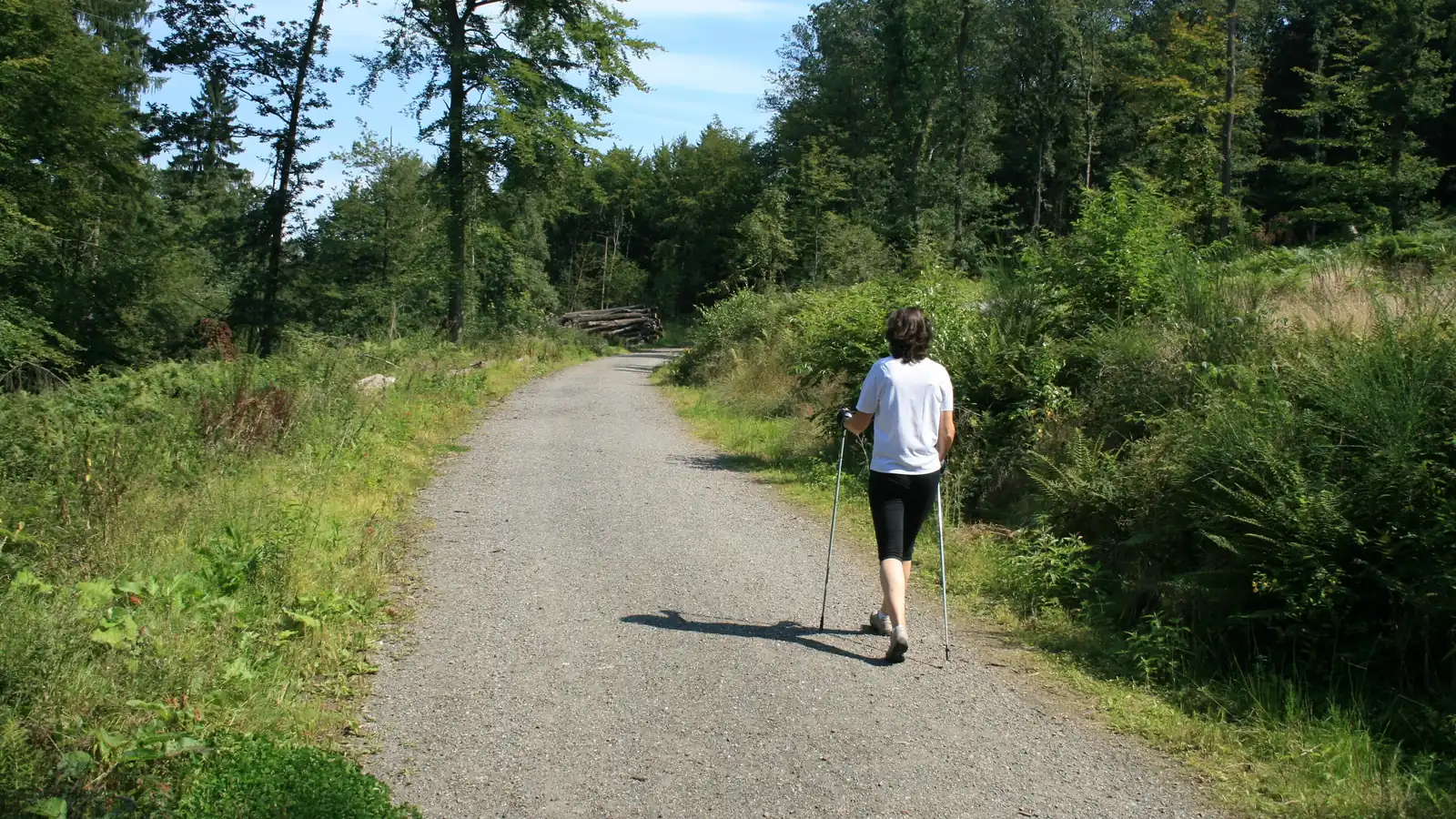
Photo: Nordic walking in Herdecke, Germany, by Ft-nrw, CC BY-SA 3.0, via Wikimedia Commons. Cropped to fit.
Nordic walking is ordinary walking with a pair of specially designed poles. You plant the poles behind you and push off with each stride, so your arms, shoulders and core join in. It started in Finland as summer training for cross-country skiers and is now a popular low-impact way to get fitter. This guide covers what the research says, how to choose poles, the basic technique and where to learn in Brisbane and New South Wales.
Quick answer: what is Nordic walking?
- What it is: fitness walking with poles that you actively push against, rather than just carrying them.
- Where it comes from: Finland. It grew out of off-season training for cross-country skiers and was formally described by Mauri Repo in 1979. The name "Nordic Walking" was popularised by the Finnish pole maker Exel in the late 1990s (Wikipedia).
- Why people do it: studies show it raises your heart rate and energy use compared with walking without poles, while it doesn't feel much harder.
- What you need: a pair of Nordic walking poles, comfortable walking shoes and a flat path to start on.
- Who it suits: most adults, including older adults. Check with your GP first if you have a heart condition, joint problems or other health concerns.
Nordic walking benefits: what the research says
It works more of your body
Because you push through the poles, your upper body does real work. In a US study of 22 adults walking 1,600 metres with and without poles (Church et al., 2002), Nordic walking increased oxygen use by about 20% and energy use from 4.6 to 5.4 Calories (kcal) per minute in women and from 5.7 to 6.9 in men. Importantly, people didn't rate it as feeling significantly harder.
It can improve heart health and fitness
A systematic review in the American Journal of Preventive Medicine (Tschentscher et al., 2013) pooled 16 randomised controlled trials (1,062 people) and 11 observational studies (831 people). Nordic walking improved resting heart rate, blood pressure, exercise capacity, maximal oxygen uptake and quality of life across a range of conditions. The authors concluded it has beneficial effects on many health measures and may be better than brisk walking on several of them.
It can help older adults stay active
A 2018 review in Rejuvenation Research (Bullo et al., 2018) looked at 15 studies of people aged 60 to 92. Compared with staying sedentary, Nordic walking improved aerobic capacity, muscle strength, dynamic balance and quality of life. The same review also found some limits, which are covered below.
What the research doesn't show
- It's not a shortcut. Benefits come from doing it regularly, just like any walking.
- Technique matters. If you carry the poles without pushing, you lose most of the extra effort.
- Ordinary walking still wins on some measures. In the 2018 review of older adults, regular walking improved aerobic capacity more than Nordic walking in one comparison, and one study found a negative effect on static balance.
- Many studies are small. Results vary between groups, so treat claims about exact calorie numbers with caution.
Note: the 2002 study reported energy in kilocalories (Calories) per minute. Australian food labels use kilojoules: 1 Calorie is about 4.2 kilojoules.
How Nordic walking fits the Australian guidelines
Australia's 24-hour movement guidelines for adults recommend 30 minutes or more of moderate-to-vigorous activity on most days, muscle-strengthening activities on 2 or more days a week, and activities for mobility, balance and coordination on 3 or more days a week. The recommendations for older adults follow the same pattern.
A brisk 30-minute Nordic walk counts towards your moderate-to-vigorous minutes, and walking on varied ground helps with balance and coordination. It isn't a replacement for strength training, so keep some muscle-strengthening work in your week. healthdirect lists Nordic walking as one of several walking styles and suggests warming up for 5 minutes before you start. For the full picture, read our guide to the physical activity guidelines in Australia.
Nordic walking poles: how to choose
Nordic walking poles aren't the same as hiking or trekking poles, although they look similar.
| Feature | Nordic walking poles | Trekking poles |
|---|---|---|
| Main job | Push you forward and add upper-body work | Support and stability on steep or rough ground |
| How you use them | Planted behind you at an angle | Planted in front or beside you |
| Grip and strap | Glove-style strap so you can open your hand and push | Simple loop strap and a grip you hold |
| Tips | Angled rubber "paws" for paths, metal tips for trails, sand and grass | Usually metal or rubber tips |
Fixed or adjustable?
One-piece poles are usually lighter and stronger but need to match your height. Adjustable (telescopic) poles suit beginners, fit in the car and can be shared.
What length?
When you hold the grip with the tip on the ground beside your foot, your elbow should be close to a right angle. Most brands publish a sizing chart. A certified instructor can check your fit in the first lesson.
How to Nordic walk: basic technique
- Start without pushing. Walk normally and let the poles drag behind you, held loosely by the straps. Your arms will swing naturally, opposite to your legs.
- Plant the poles. As your arm swings forward, let the pole tip land roughly level with your back foot, angled backwards.
- Push through the strap. Press down and back through the strap as you walk past the pole. Open your hand at the end of the push and let the strap bring the grip back.
- Lengthen your stride. A longer arm swing naturally lengthens your step and gets your upper body rotating.
- Stay tall. Keep your shoulders relaxed, your head up and your eyes forward.
The easiest way to get it right is a short course with an instructor. Nordic Walking Australia lists instructors certified by the International Nordic Walking Federation (INWA), who run group lessons and one-on-one sessions.
Safety tips for Queensland conditions
- Beat the heat. Walk early or late in the day, carry water and wear a hat and sunscreen, as healthdirect recommends.
- Start on flat paths. Learn the technique on even ground before tackling bush tracks or hills.
- Change your tips. Use the rubber paws on concrete and boardwalks, and take them off on dirt, grass or sand.
- Mind other path users. Keep your poles close on shared paths and boardwalks.
- Talk to your GP first if you have a heart or lung condition, high blood pressure, joint or balance problems, or haven't exercised in a while.
Where to learn Nordic walking
Brisbane
Nordic Walking Brisbane runs classes from Teneriffe Physiotherapy, with sessions in inner-city parks such as New Farm Park, Teneriffe Park and Waterfront Park in Newstead, plus Minnippi Parklands, Grinstead Park in Alderley, Banks Street Reserve in Newmarket and Gap Creek Reserve at Mt Coot-tha. Check their website for current times, free come-and-try sessions and prices.
New South Wales
The Nordic Walking Australia instructor list includes instructors in Sydney, the Central Coast, the Hawkesbury and Coffs Harbour.
Prefer a group walk?
Free Heart Foundation Walking groups meet across Queensland. Many walkers bring poles, and it's an easy way to find a regular walking buddy. See our guide to walking groups for more options.
Walks to try with your poles
Once you have the technique, these walks from the Brisbane walks and trails hub suit Nordic walking:
- Boondall Wetlands. Flat paths and boardwalks for your first sessions. Keep the rubber paws on for the Tabbil-ban dhagun Boardwalk quest, or try the Billai Dha-gun Track quest.
- Karawatha Forest. Gentle forest tracks in Brisbane's south. See the Ironbark Circuit quest.
- Daisy Hill Conservation Park. A short, easy loop. See the Tree Discovery Trail quest.
- Mt Coot-tha. Hillier bush tracks where poles really help on the climbs. Try the Kokoda Trail quest or the Mt Coot-tha Summit Track quest.
Further afield, the coastal tracks in the Sunshine Coast walks hub and the Muttonbird Island walk in Coffs Harbour make good pole walks too. Check Queensland Parks or NSW National Parks for track conditions and closures before you go.
Want more walking ideas? Read about the benefits of walking, Japanese walking, how many steps a day you need and hiking for beginners.
Frequently asked questions
Is Nordic walking good for you?
Yes, for most people. A 2013 review of 27 studies found Nordic walking improved resting heart rate, blood pressure, exercise capacity and quality of life, and a 2018 review found benefits for adults aged 60 and over. As with any new exercise, check with your GP first if you have a health condition.
What are the benefits of walking with poles?
Pushing through the poles brings your arms, shoulders and core into the walk. In one study, people used about 20% more oxygen and burned more energy than walking without poles, without feeling that they were working much harder.
Is Nordic walking better than normal walking?
It can be harder work at the same pace, and some studies found bigger improvements than brisk walking. But ordinary walking also has strong health benefits, and one review found it improved aerobic capacity more in older adults. The best walk is the one you'll keep doing.
Can I use hiking poles for Nordic walking?
You can try it, but trekking poles are designed for support rather than pushing. Nordic walking poles have glove-style straps and angled rubber tips that make the push-off technique easier.
How long should Nordic walking poles be?
With the tip on the ground beside your foot, your elbow should be close to a right angle. Follow the brand's sizing chart, or use adjustable poles while you learn.
Is Nordic walking good for bad knees?
The poles can help with balance and rhythm, but research on whether they reduce load on the knees is mixed. If you have knee pain or arthritis, ask your GP or physiotherapist whether it suits you.
Tours & experiences near the Sunshine Coast & Noosa
Earn as you explore
Active Quests turns walks into GPS check-in quests where you earn ACTIVE Coins on the trail. Get it on the App Store.