
30-Day Walking Challenge: A Free, Evidence-Based Plan
Published 11 November 2026
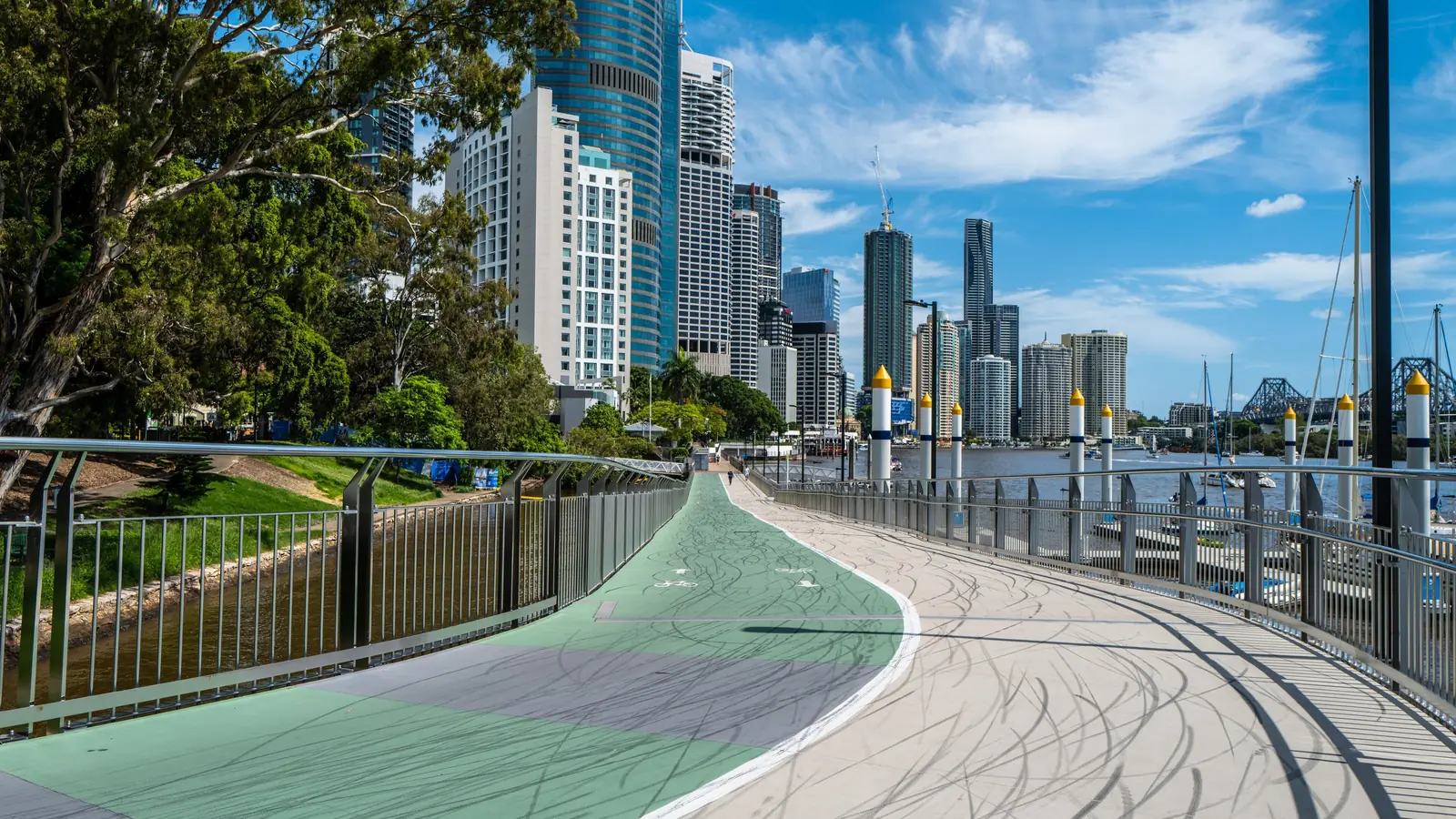
Photo: City Botanic Gardens Riverwalk, Brisbane, by John Robert McPherson, CC BY-SA 4.0, via Wikimedia Commons. Cropped to 16:9.
Short answer: a good 30-day walking challenge starts from your current step count, not someone else's. Add a little each week until you're doing 30 minutes or more of brisk walking on most days, which is the Australian Government's recommendation for adults. If you track steps, aim to finish the month at 7,000 or more a day. The plan below does that in four weeks, and it ends on a real walking trail.
This guide is for everyday walkers who want a simple, free structure. It isn't medical advice. If you have a health condition, are pregnant, or haven't been active for a long time, check with your GP before you step things up.
Quick facts: the 30-day walking challenge
- Goal by day 30: 30+ minutes of moderate-to-vigorous activity (brisk walking counts) on most days, as set out in the Australian adult guidelines.
- Step target (optional): 7,000 or more steps a day, the companion figure for people who track steps, explained by the 10,000 Steps program at CQUniversity.
- Starting point: your own baseline, meaning your average daily steps over a normal week.
- Rule of thumb: 10 minutes of moderate activity is about 1,000 steps (10,000 Steps program conversion).
- Extras: muscle-strengthening on 2 or more days a week and balance work on 3 or more days, as the guidelines recommend.
- Cost: free. You need comfortable shoes, water and a phone or watch that counts steps.
Why a challenge works better than "walk more"
Vague goals are easy to skip. A clear target, a way to track it and a bit of game-style motivation make it more likely you'll actually lace up.
- Step goals help. A 2007 systematic review in JAMA pooled 26 studies of pedometer use (2,767 people). In the randomised trials, pedometer users walked about 2,491 more steps a day than controls. Overall, activity rose 26.9% over baseline, and having a step goal was an important predictor of success. The authors noted it wasn't clear how long the gains lasted.
- Games and friendly competition help too. In the STEP UP randomised trial (602 US adults, JAMA Internal Medicine, 2019), people set a step goal from their own baseline and played a 24-week game with points and levels. The competition group added about 920 steps a day more than controls. Activity dropped once the game stopped, though the competition group stayed ahead.
The takeaway for a 30-day challenge: set a goal from your baseline, track it daily, and build in a social or game element. Then plan what keeps you going on day 31.
Before you start: find your baseline
The 10,000 Steps team suggests starting with your baseline, then trying to beat it. For a normal week, just carry your phone or wear your watch and don't change anything. Take your average daily steps; that's your Day 0 number.
Then pick a goal style. The 10,000 Steps program describes two that both have merit:
- Specific goal: "I'll add 1,000 steps to my daily average by the end of the month." Good if you like structure.
- Open goal: "See how many steps I can reach today." Good if you're starting out or coming back, because there's no pass/fail.
You can mix them. Use an open goal on hard days and a specific goal when you have momentum.
The 30-day walking plan
Each week builds on the last. If a week feels too hard, repeat it. Progress beats perfection.
| Week | Daily target | Walks | Extras |
|---|---|---|---|
| 1 (days 1–7) | Baseline + about 1,000 steps (one extra 10-minute walk) | Short walks at an easy-to-moderate pace | Notice how you feel; no extras yet |
| 2 (days 8–14) | Baseline + about 2,000 steps | A 20-minute brisk walk on 5 days | 2 short strength sessions (for example sit-to-stands, wall push-ups) |
| 3 (days 15–21) | 30 minutes of brisk walking on most days | Add one hill or stairs session; one longer weekend walk | Balance work on 3 days (for example single-leg stands while the kettle boils) |
| 4 (days 22–30) | 30+ minutes on most days; 7,000+ steps if you track | Finish with a weekend trail walk | Keep 2 strength days and 3 balance days |
"Brisk" means you can still talk but you'd struggle to sing. The adult guidelines also call for several hours of light activity every day and breaking up long periods of sitting, so gentle steps around the house and office still count.
Easy ways to add 1,000 steps
- Walk the first or last 10 minutes of your commute.
- Take phone calls on foot.
- Do a 10-minute loop of the block after dinner.
- Park at the far end of the car park, or get off the bus a stop early.
Make it a trail challenge
Streets and footpaths are perfect for weekdays. For your weekend walks, a trail adds hills, uneven ground and views, which makes the time go faster. With Active Quests you choose a real trail, check in at GPS checkpoints along the way and earn ACTIVE Coins when you complete the quest. It's a ready-made game layer for your challenge.
A few weekend ideas, from easy to harder:
- Brisbane: the Mount Coot-tha Summit Track (see our summit track guide), the Kokoda Trail at Mt Coot-tha or the Mount Gravatt summit track in Toohey Forest. Browse every Brisbane walk.
- Gold Coast: the Burleigh Head National Park trail, a coastal walk you can link with a swim.
- Sunshine Coast: the Noosa Headland coastal track or the Tibrogargan circuit in the Glass House Mountains (see our Glass House Mountains walks guide).
- Hinterland waterfall: the Kondalilla Falls circuit, a good week-4 finale.
New to trails? Read hiking for beginners and pack from our hiking essentials checklist.
Walking in the heat (November to March)
A summer challenge in Queensland or northern NSW means planning around the heat. healthdirect advises being prepared for hot weather, staying out of the sun and drinking plenty of water to avoid heatstroke. In practice:
- walk early in the morning or in the evening, and pick shady or coastal routes in the middle of the day
- carry water and wear a hat and sunscreen
- slow down or stop if you feel dizzy, confused or have a headache. healthdirect lists these among the warning signs of heatstroke, which is a medical emergency: call triple zero (000).
Do it with other people
Company is the easiest motivation hack there is. Heart Foundation Walking has supported free walking groups since 1995, with groups across Queensland and a Walker Rewards program for milestones. Ask a friend or workmate to do the 30 days with you and compare totals each Sunday.
More options: our guides to walking groups, run clubs in Brisbane (walkers welcome) and parkrun on the Gold Coast, where you can walk the free Saturday 5 km.
Steps or minutes: what should you track?
Either works. Steps are simple and most phones count them automatically. Minutes suit activities that aren't walking, like swimming or cycling. The 10,000 Steps program lets you convert minutes to step equivalents (10 minutes of moderate activity is about 1,000 steps). A simple system:
- Daily: your step count against your weekly target.
- Weekly: total minutes of brisk walking or exercise, plus your strength and balance days.
For the numbers behind the 7,000-step target, see how many steps a day you really need and our explainer on the Australian physical activity guidelines.
Frequently asked questions
What is a 30-day walking challenge?
It's a month-long plan to walk a little more each week, usually toward a step or minutes target. This one starts from your own baseline and builds to 30 minutes or more of brisk walking on most days, the Australian guideline for adults, with an optional 7,000+ steps a day.
How many steps should I walk in a walking challenge?
Start from your baseline and add about 1,000 steps a day each week or two. If you track steps, Australia's companion guidance suggests aiming for 7,000 or more steps per day.
Is walking 30 minutes a day enough?
For adults, the Australian guidelines recommend 30 minutes or more of moderate-to-vigorous activity on most days, plus muscle-strengthening on 2 or more days and balance and mobility activities on 3 or more days. Brisk walking counts toward the 30 minutes.
Do walking challenges actually work?
Research suggests they can. A 2007 JAMA review found pedometer users increased activity by 26.9% over baseline, and having a step goal was an important predictor. In the 2019 STEP UP trial, a points-and-levels game with competition added about 920 steps a day compared with controls.
What if I miss a day?
Carry on the next day. The guidelines say "most days", not every day. If a whole week goes badly, repeat that week instead of skipping ahead.
Can I do the challenge on a treadmill or in a shopping centre?
Yes. Every step counts. Indoor walking is a good option on very hot or wet days. Try to fit in at least one outdoor or trail walk a week for hills, fresh air and variety.
The bottom line
Start from your own number, add a little each week, and aim to finish the month walking briskly for 30 minutes or more on most days. Track it daily, bring a friend, and make your week-4 walk a trail you've never done before. Find a trail quest near you to turn it into a game. Active Quests is available on the App Store.
Sources
- Australian Government Department of Health, Disability and Ageing: Recommendations for adults (18 to 64 years)
- 10,000 Steps (CQUniversity): 7,000 steps a day: what the new guidelines mean for goal setting
- Bravata DM et al. Using pedometers to increase physical activity and improve health: a systematic review. JAMA 2007;298(19):2296–2304. doi:10.1001/jama.298.19.2296
- Patel MS et al. Effectiveness of behaviorally designed gamification interventions with social incentives for increasing physical activity among overweight and obese adults across the United States: the STEP UP randomized clinical trial. JAMA Internal Medicine 2019;179(12):1624–1632. doi:10.1001/jamainternmed.2019.3505
- healthdirect: Heatstroke
- Heart Foundation Walking: Find a walking group in Queensland